
Upstox Business Model of Brokerage Fees and Depository Services
How Upstox earns from trading fees, depository charges and other services.

Key Takeaways
- FY25 total income was about ₹1,208 crore, up 8.6% from about ₹1,112 crore.
- Upstox reported a profit of ₹215 crore in FY25, the year to March 2025.
- Upstox crossed 2 crore fully KYC-registered customers in August 2026.
- It had 18.43 lakh NSE active clients in October 2026, fifth among brokers.
Table of Contents 15 sections
- Upstox at a glance
- What Upstox does
- How Upstox makes money
- Upstox revenue model in numbers
- Upstox's Business Model Canvas
- Is Upstox profitable
- Upstox customers and active clients
- Upstox's journey so far
- Upstox owner and valuation
- Upstox IPO plans
- Upstox US stock investing
- Who Upstox competes with
- Challenges Upstox faces
- Conclusion on the Upstox business model
- FAQs
The Upstox business model is built on an online broking app: customers open a demat and trading account, buy and sell shares and derivatives, and pay Upstox a fee of up to ₹20 on each executed order. Its total income was about ₹1,208 crore in FY25 (the year to March 2025).
Upstox, run by RKSV Securities India Private Limited, reported a profit of ₹215 crore in FY25.
Upstox at a glance
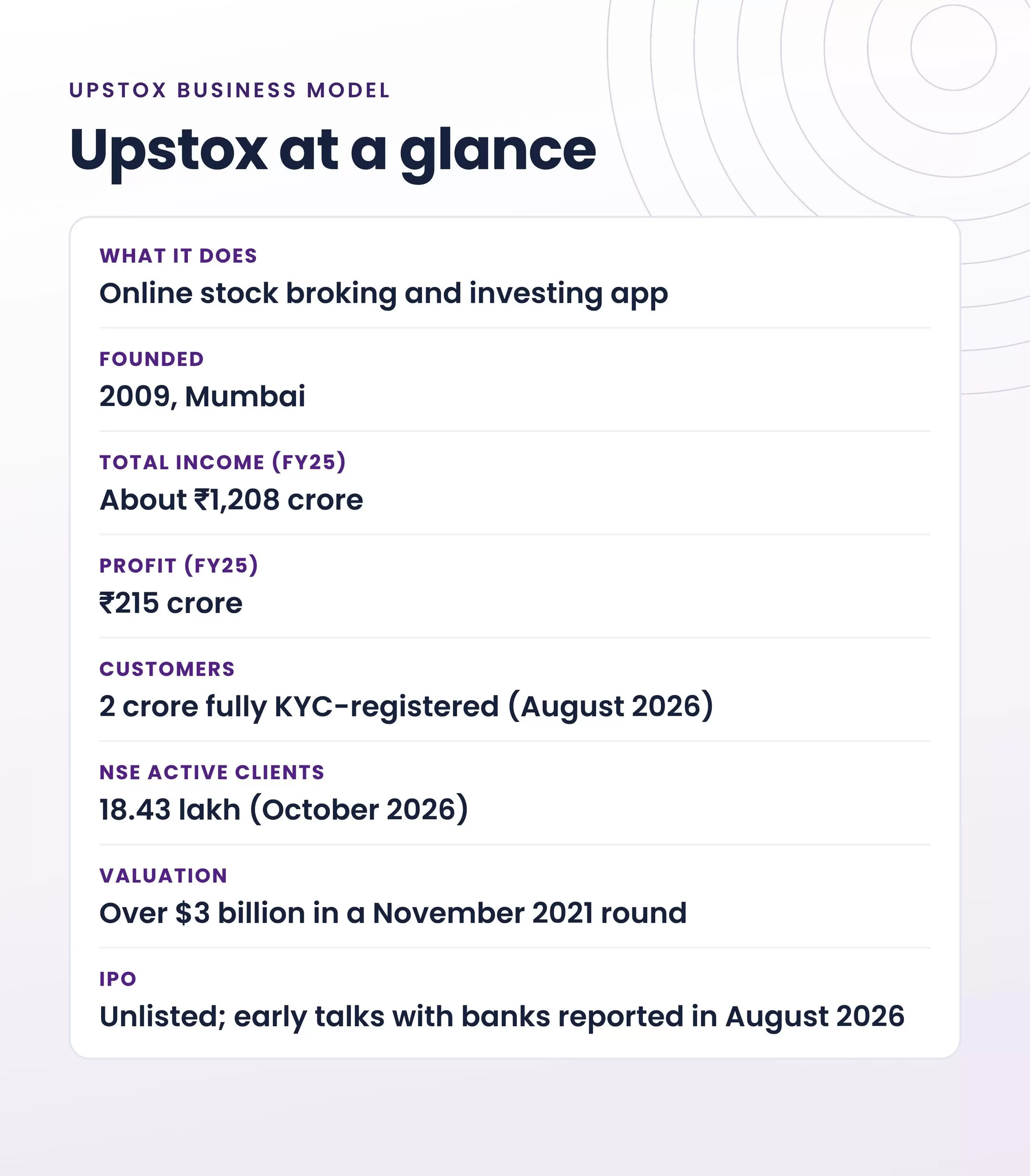
| Detail | Upstox |
|---|---|
| What it does | Online stock broking and investing app |
| Company | RKSV Securities India Private Limited, Mumbai |
| Founded | 2009 |
| Co-founders | Ravi Kumar, Raghu Kumar, Shrini Viswanath and Kavitha Subramanian |
| Total income (FY25) | About ₹1,208 crore |
| Profit (FY25) | ₹215 crore |
| Customers | 2 crore fully KYC-registered (August 2026) |
| NSE active clients | 18.43 lakh (October 2026) |
| Valuation | Over $3 billion in a November 2021 round with Tiger Global |
| IPO status | Unlisted; early talks with banks for an IPO of about $400 million were reported in August 2026 |
What Upstox does
Upstox runs a mobile app and a web platform where people in India can buy and sell shares, futures and options, commodities and currencies. It also offers mutual funds, IPO applications, fixed deposits, bonds, insurance and US stocks through the same account.
The broking business sits in Upstox Securities Private Limited, a wholly owned subsidiary of RKSV Securities India Private Limited. It is a SEBI-registered broker and a member of NSE, BSE, MCX and CDSL.
Upstox says over 85% of its customers come from Tier 2 and Tier 3 cities, and nearly 70% are first-time investors.
How Upstox makes money
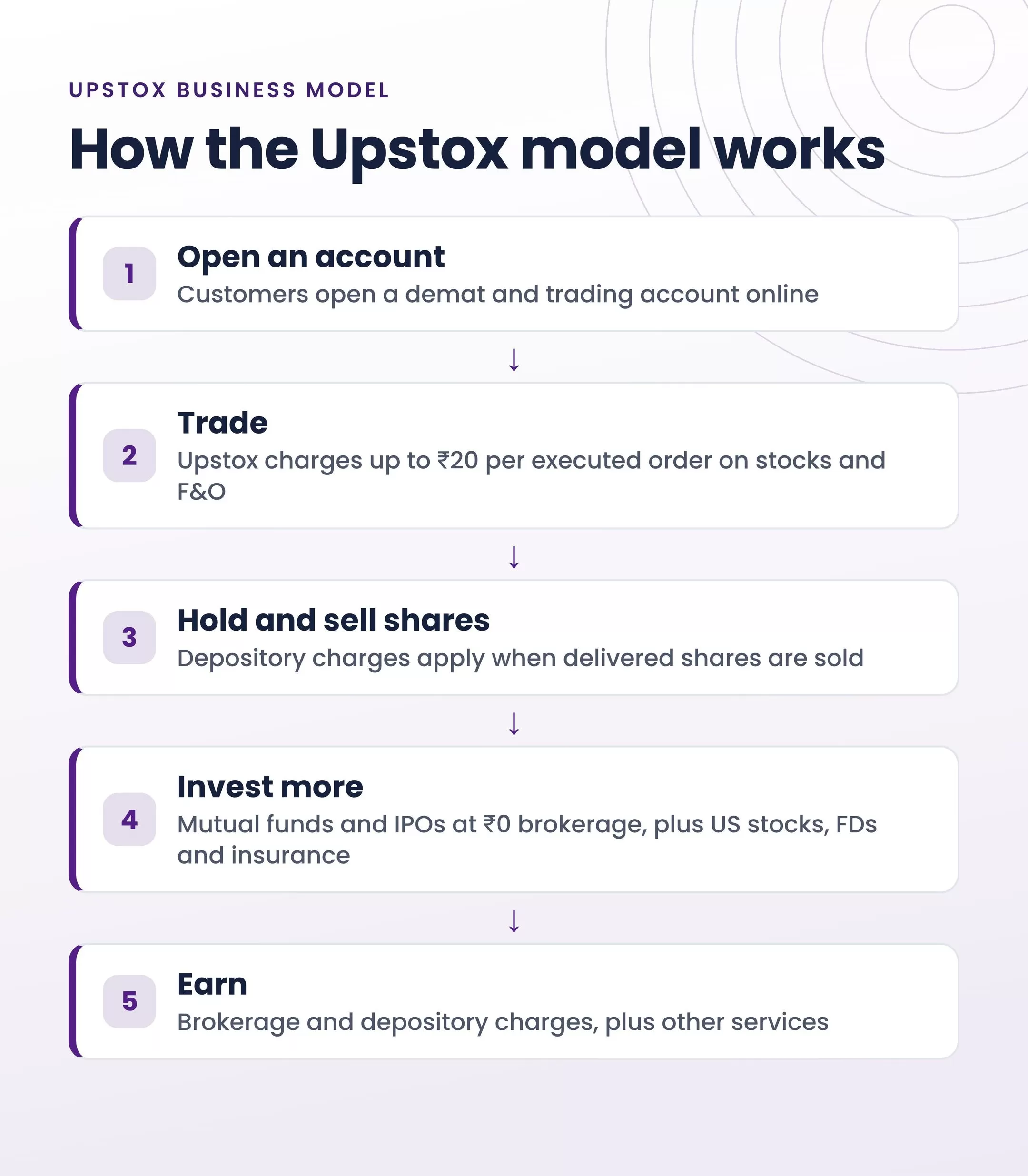
Upstox's price list shows two kinds of fees on trading: brokerage on each executed order and a depository charge when delivered shares are sold. Its app also offers products such as fixed deposits, insurance and US stocks.
- Brokerage: the fee Upstox charges on each executed order. Its current price list shows ₹20 per executed order for equity delivery, ₹20 or 0.1% (whichever is lower) for intraday, ₹20 or 0.05% (whichever is lower) for futures, and a flat ₹20 for options.
- Depository charge: ₹20 per scrip per day, charged only when delivered shares are sold.
Mutual funds and IPOs carry ₹0 brokerage on Upstox.
Upstox revenue model in numbers
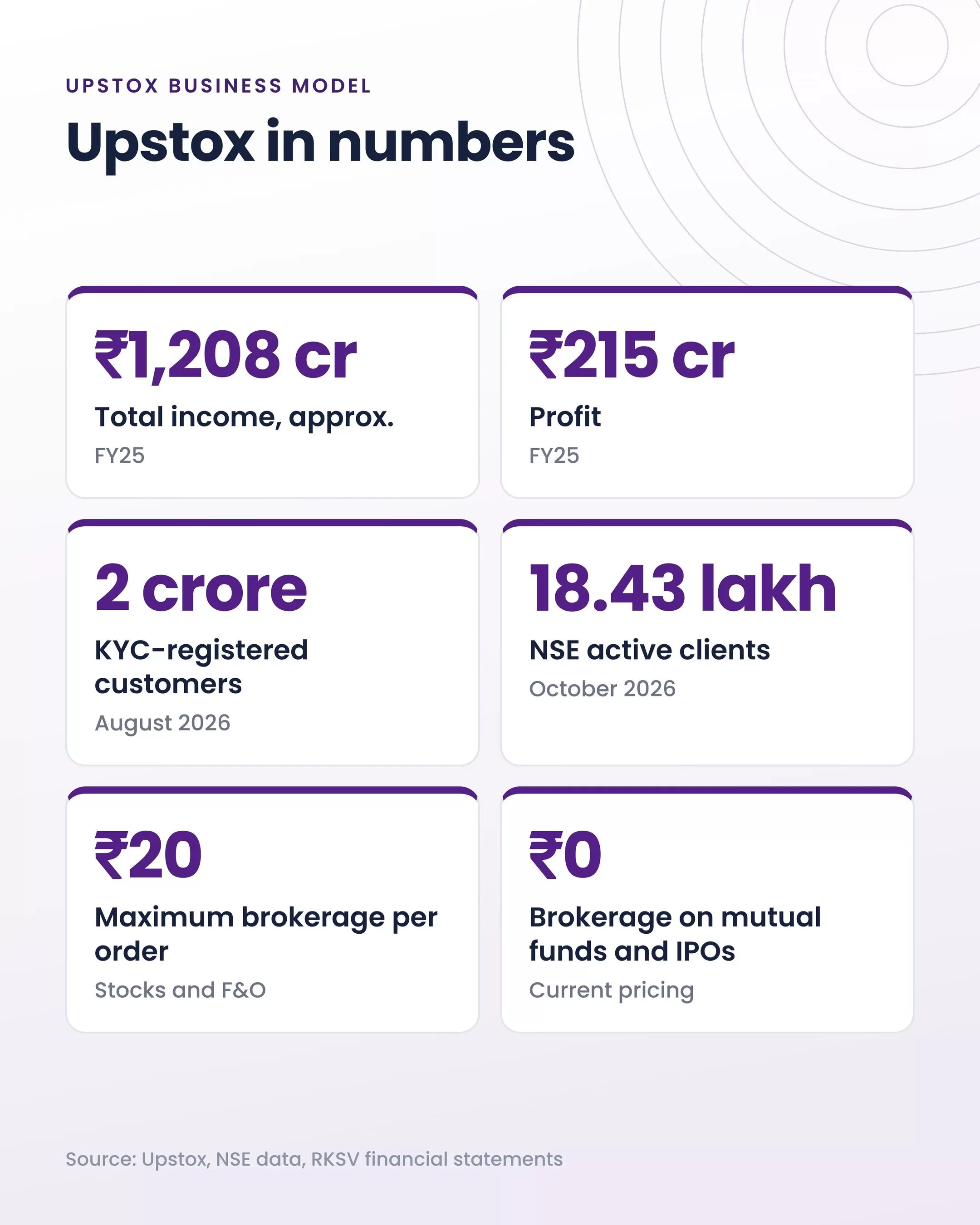
Because brokerage is a fee per order, the amount Upstox earns from it depends on how many orders its customers place. A customer who trades often pays brokerage many times, while one who only buys mutual funds pays no brokerage.
Upstox's Business Model Canvas
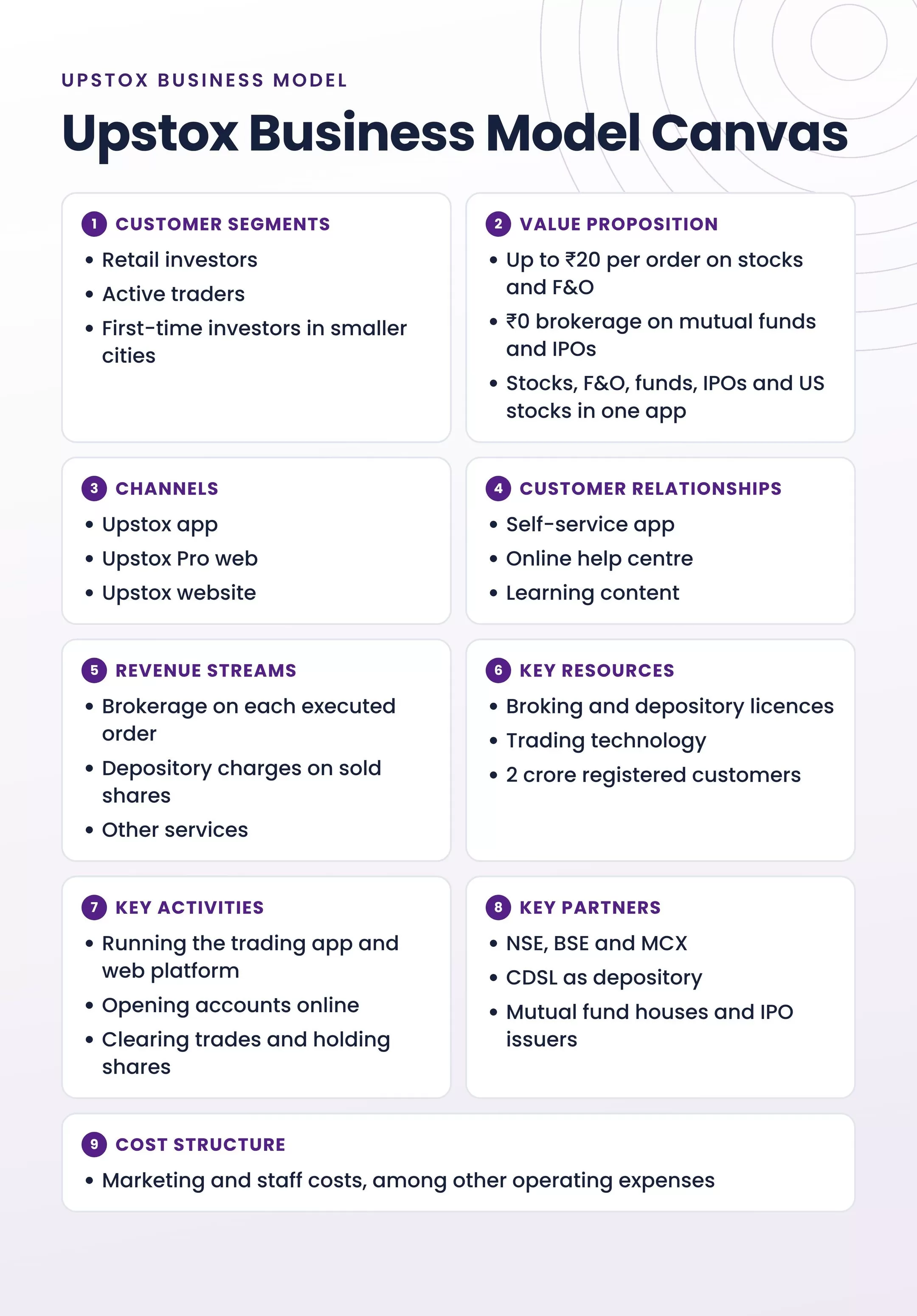
The canvas puts the whole model on one page: who Upstox serves, what it offers, how it reaches customers, what it needs to run, and how money comes in.
Is Upstox profitable
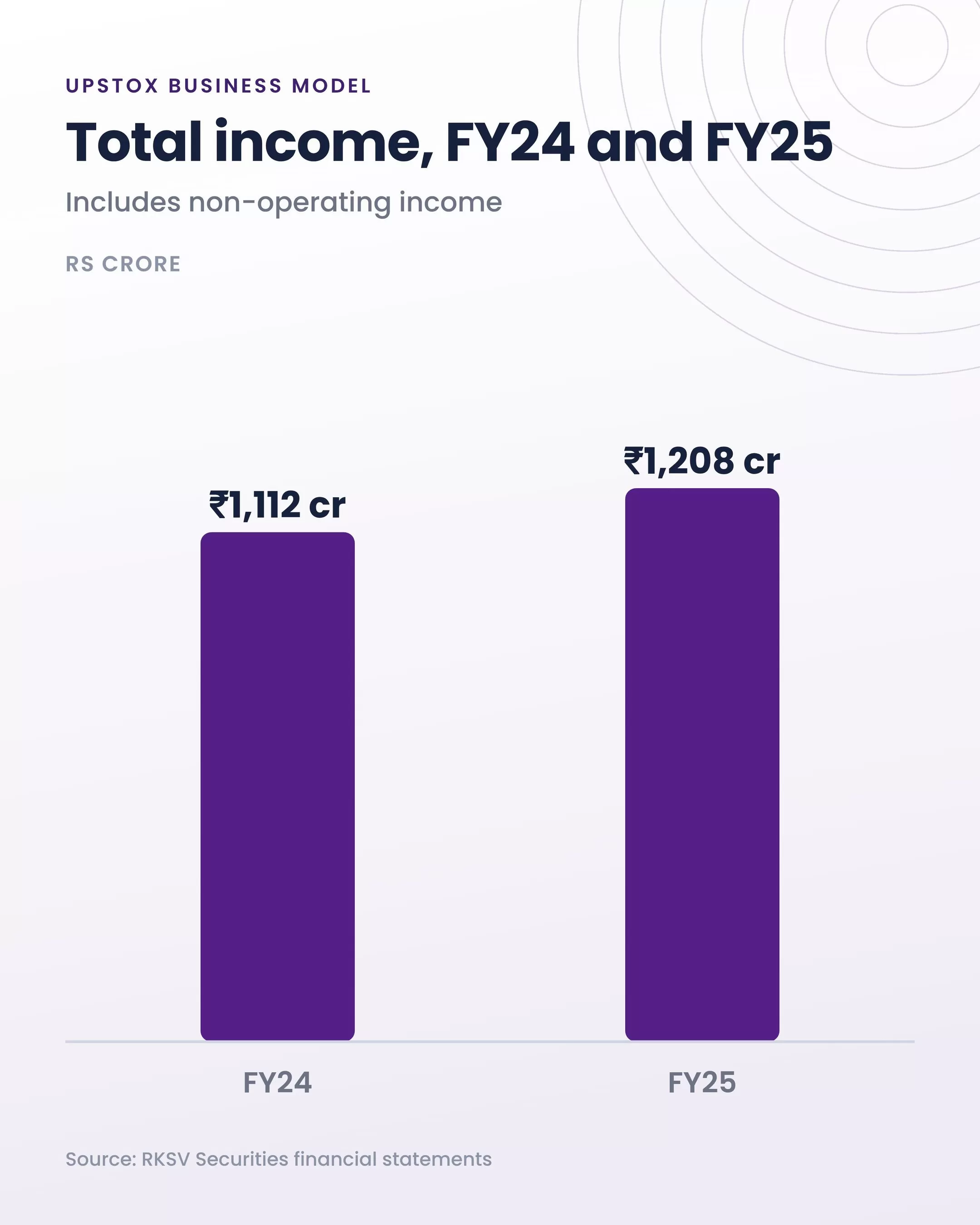
Yes. Upstox reported a profit of ₹215 crore in FY25. Its total income, which includes non-operating income, was about ₹1,208 crore in FY25, up 8.6% from about ₹1,112 crore in FY24.
| Year | Total income (₹ crore) |
|---|---|
| FY24 | About 1,112 |
| FY25 | About 1,208 |
Upstox customers and active clients
Upstox reached 10 lakh customers in June 2020 and 1 crore in May 2022, ten times as many in under two years. In August 2026 it said it had crossed 2 crore fully KYC-registered customers.
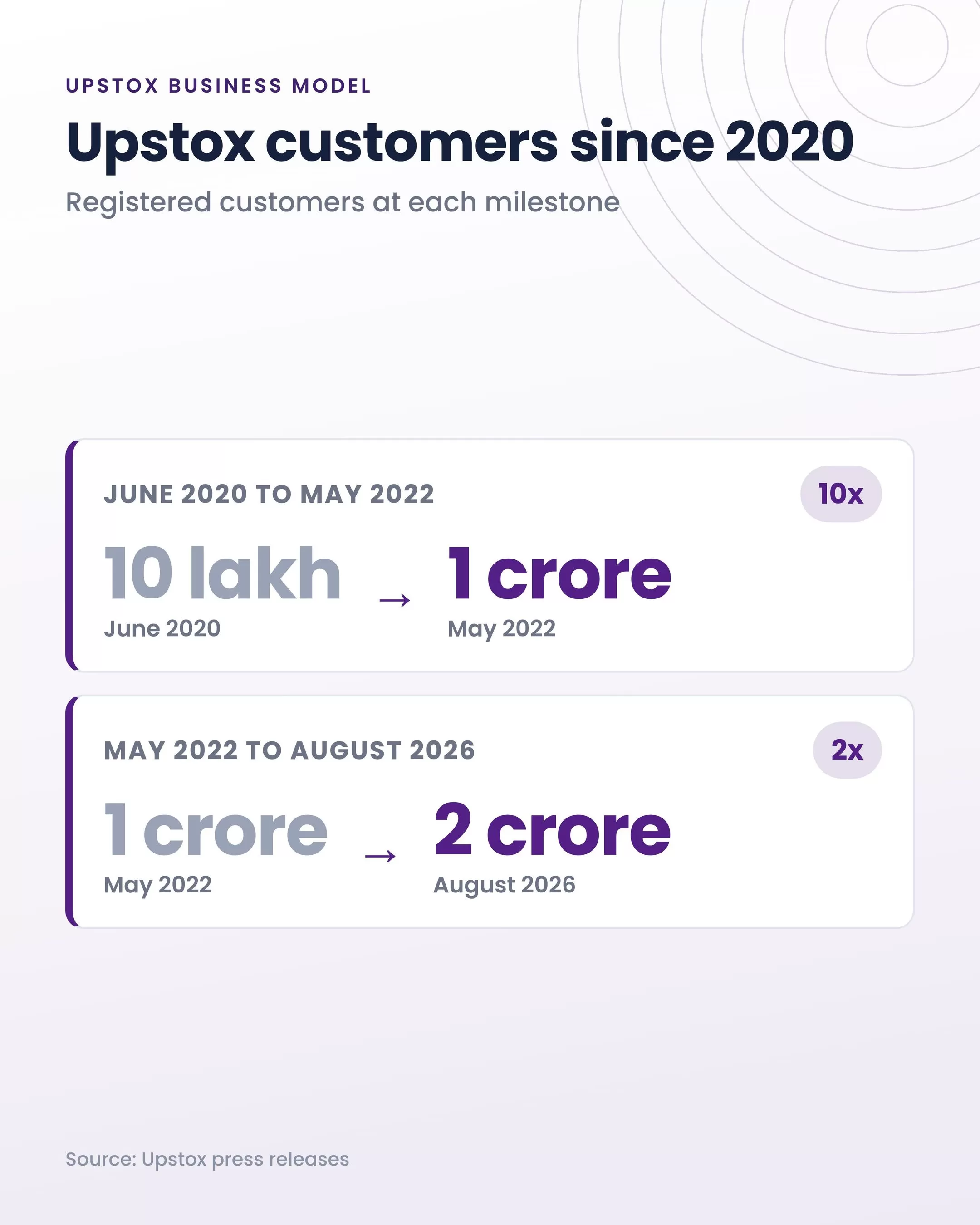
Registered customers are not the same as active traders. On NSE, Upstox had 18.43 lakh active clients at the end of October 2026.
Upstox's journey so far
| When | What happened |
|---|---|
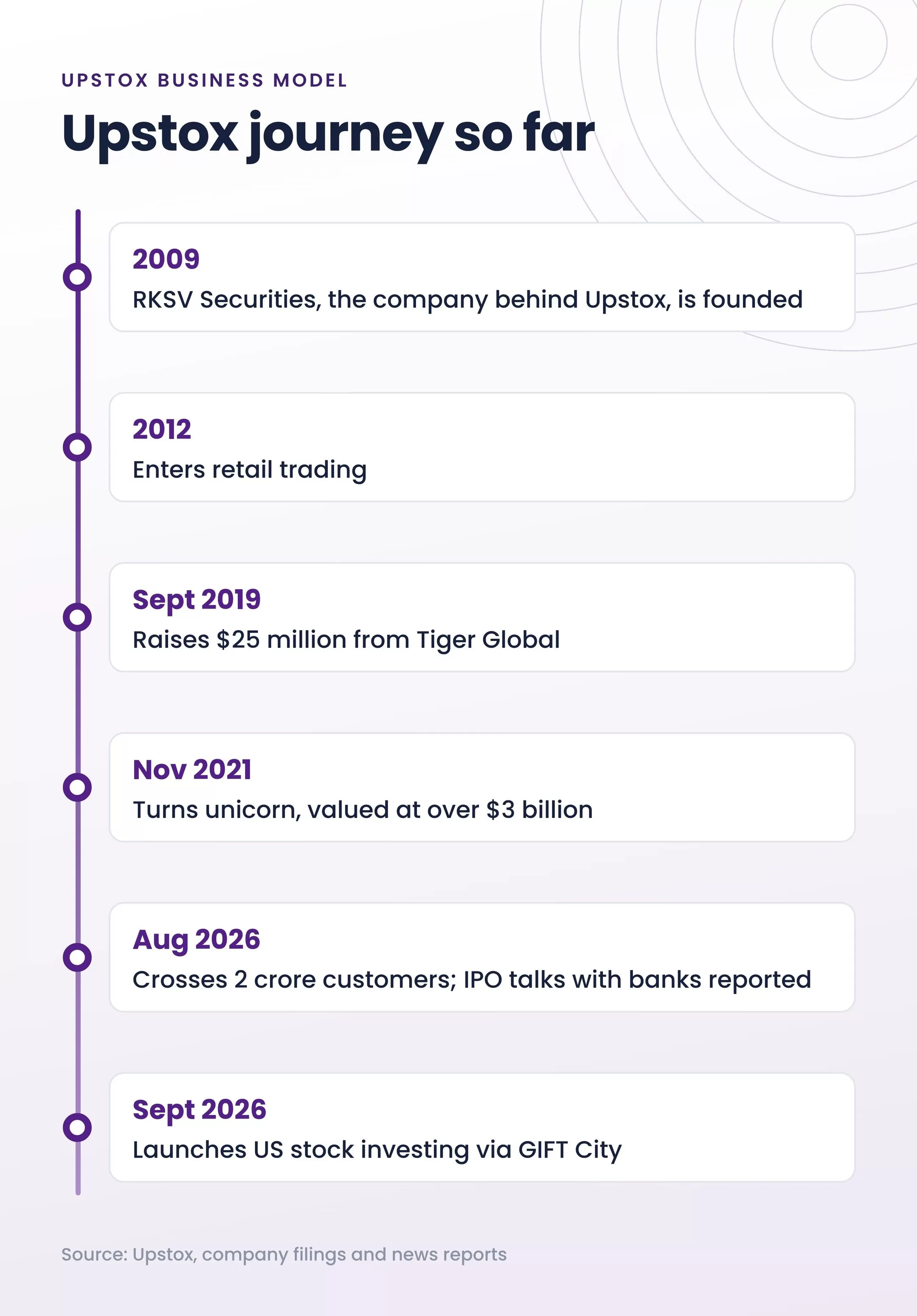
| 2009 | RKSV Securities, the company behind Upstox, is founded |
| 2012 | Enters retail trading |
| September 2019 | Raises $25 million from Tiger Global |
| June 2020 | Reaches 10 lakh customers |
| November 2021 | Raises $25 million from Tiger Global and turns unicorn, valued at over $3 billion |
| May 2022 | Crosses 1 crore customers |
| August 2026 | Crosses 2 crore customers; reports say it has begun early IPO talks with banks |
| September 2026 | Launches US stock investing through GIFT City |
Upstox owner and valuation
Upstox is privately held. Its co-founders include Ravi Kumar, Raghu Kumar, Shrini Viswanath and Kavitha Subramanian, and its investors include Tiger Global, Kalaari Capital and the late Ratan Tata. It has raised about $220 million in total.
In November 2021, Upstox raised $25 million from Tiger Global at a valuation of over $3 billion.
Upstox IPO plans
In August 2026, Bloomberg reported that Upstox had begun early talks with investment banks for an IPO that could raise about $400 million, through a mix of new shares and a sale by existing investors. Upstox did not comment, and the size and timing could change.
Upstox US stock investing
In September 2026, Upstox launched US stock investing through the IFSC branch of Upstox Securities in GIFT City, after approval from the International Financial Services Centres Authority (IFSCA). Customers can start with $1 through fractional investing, across more than 10,000 US stocks and ETFs.
Who Upstox competes with
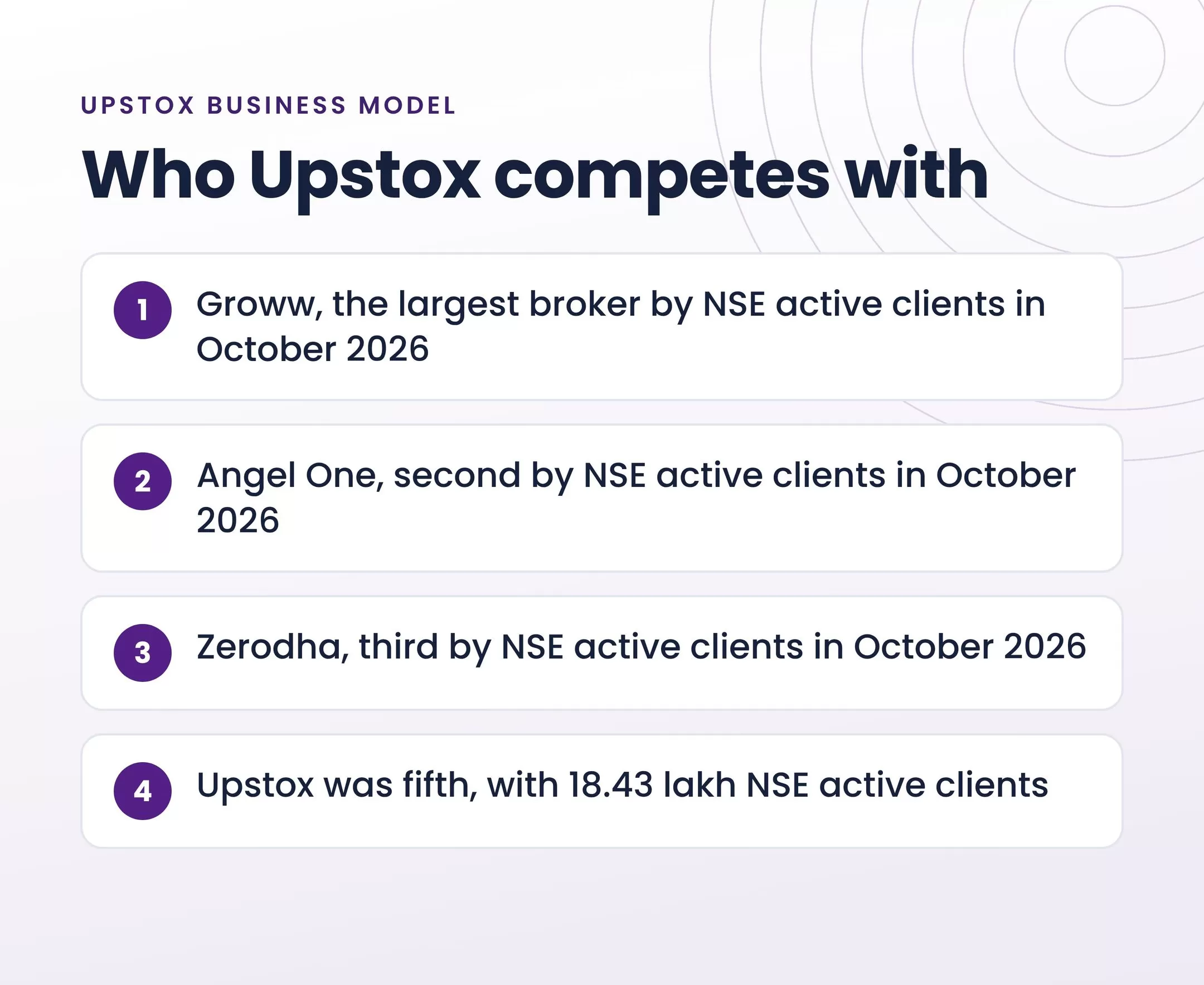
Upstox competes with other online brokers for the same investors and traders. By NSE active clients in October 2026, Groww was first with about 1.37 crore, Angel One second with 69.98 lakh and Zerodha third with 67.59 lakh. Upstox was fifth.
Challenges Upstox faces
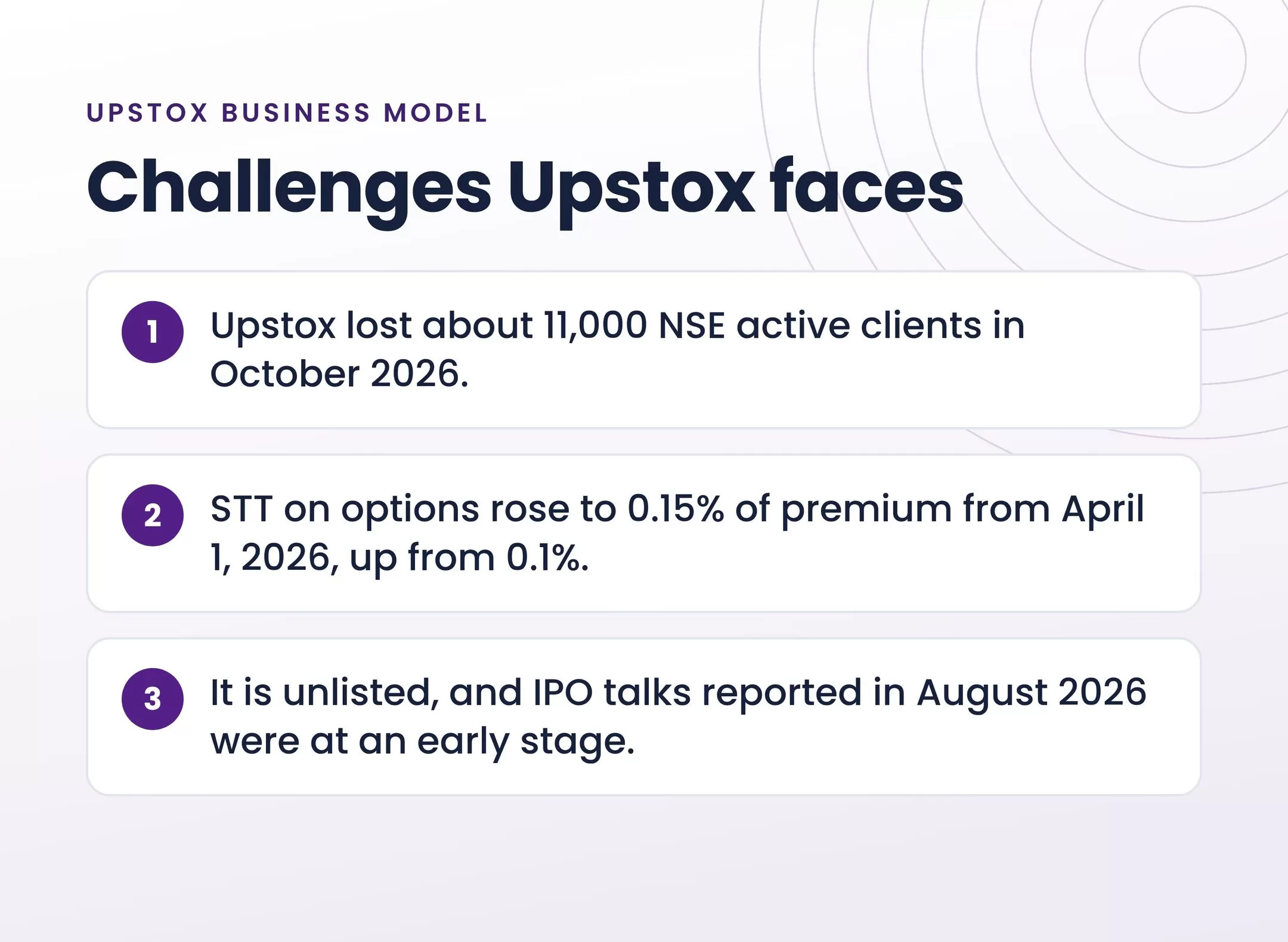
- Active clients: Upstox lost about 11,000 NSE active clients in October 2026.
- Higher trading taxes: securities transaction tax on options rose from 0.1% to 0.15% of the premium, and on futures from 0.02% to 0.05%, from April 1, 2026.
- Listing: Upstox is unlisted, and the IPO talks reported in August 2026 were at an early stage.
Conclusion on the Upstox business model
Upstox runs an app through which customers trade shares, derivatives and commodities and invest in mutual funds, IPOs and US stocks. It charges brokerage of up to ₹20 per executed order and a depository charge when delivered shares are sold, while mutual funds and IPOs carry no brokerage.
In FY25 its total income was about ₹1,208 crore and its profit was ₹215 crore. It crossed 2 crore registered customers in August 2026 and had 18.43 lakh NSE active clients in October 2026.


