How the Angel One Business Model Earns From Trades and Funding
Angel One earns fees and commission and interest on client funding.

Key Takeaways
- FY26 revenue from operations was ₹5,136.6 crore and profit was ₹915.1 crore.
- FY26 fees and commission income was ₹3,484.2 crore, interest income ₹1,631.7 crore.
- Its total user base reached 40.0 million in the quarter ended September 2026.
- The average client funding book was ₹74.5 bn in Q2 FY27, up 40.5% on a year earlier.
Table of Contents 12 sections
- Angel One at a glance
- What Angel One does
- How the Angel One business model makes money
- Angel One revenue model over five quarters
- Angel One's Business Model Canvas
- Angel One revenue and profit in FY25 and FY26
- Angel One operating metrics
- Angel One's journey so far
- Who Angel One competes with
- Where Angel One's FY26 and Q2 FY27 numbers fell
- Conclusion on the Angel One business model
- FAQs
The Angel One business model is built on digital broking. The company earns fees and commission when clients trade, and interest when clients use its margin funding. In FY26 its consolidated revenue from operations was ₹5,136.6 crore and its profit for the year was ₹915.1 crore.
Angel One is listed on NSE and BSE. It reported a total user base of 40.0 million in Q2 FY27, the quarter ended 30 September 2026, and it also offers mutual funds, wealth management, asset management and credit distribution.
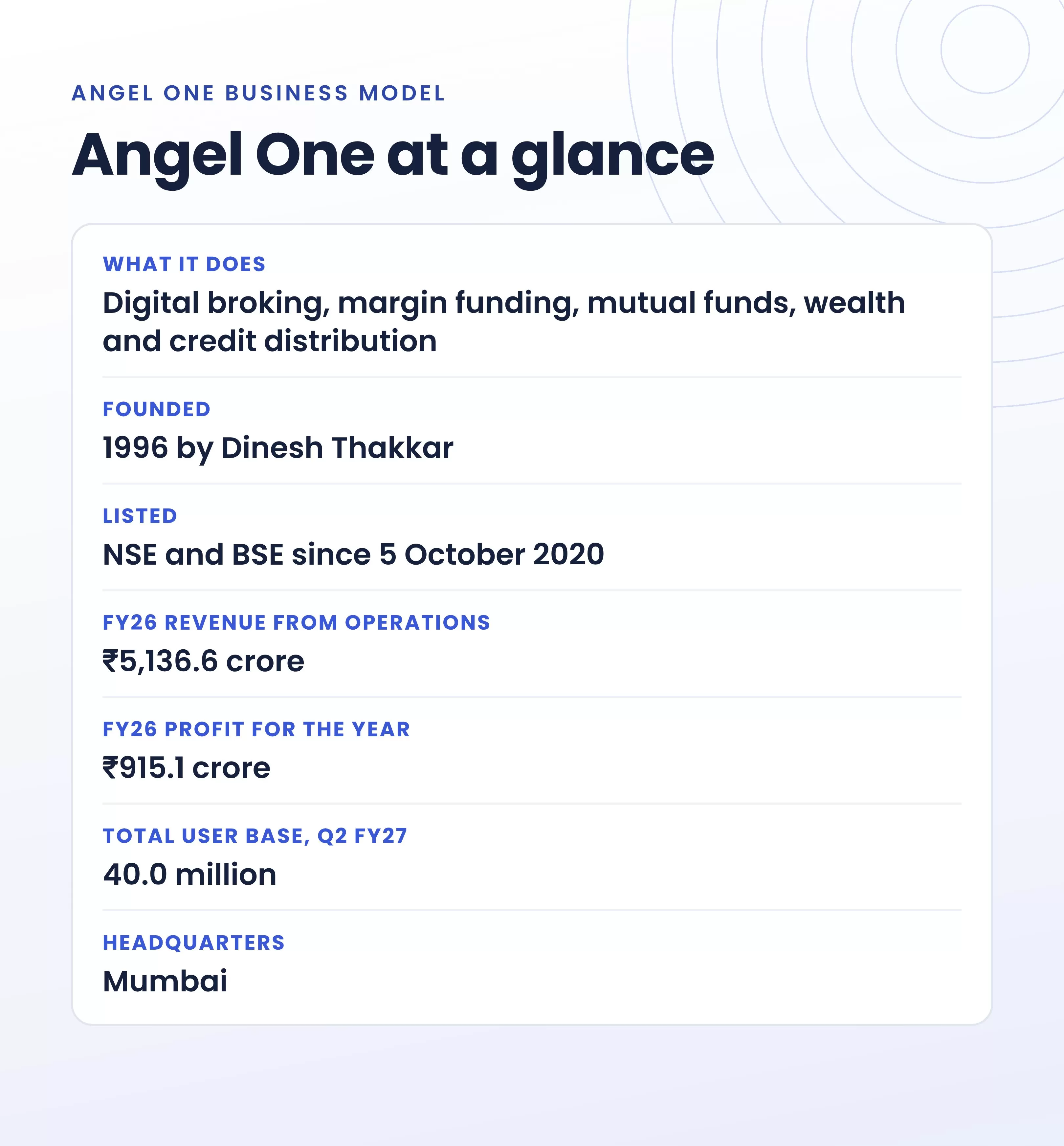
Angel One at a glance
| Item | Detail |
|---|---|
| What it does | Digital broking, margin funding, mutual funds, wealth management and credit distribution |
| Founded | 1996 by Dinesh Thakkar |
| Headquarters | Mumbai |
| Listing | NSE and BSE since 5 October 2020 |
| FY26 revenue from operations | ₹5,136.6 crore |
| FY26 total income | ₹5,152.2 crore |
| FY26 profit for the year | ₹915.1 crore |
| Total user base, Q2 FY27 | 40.0 million |
What Angel One does
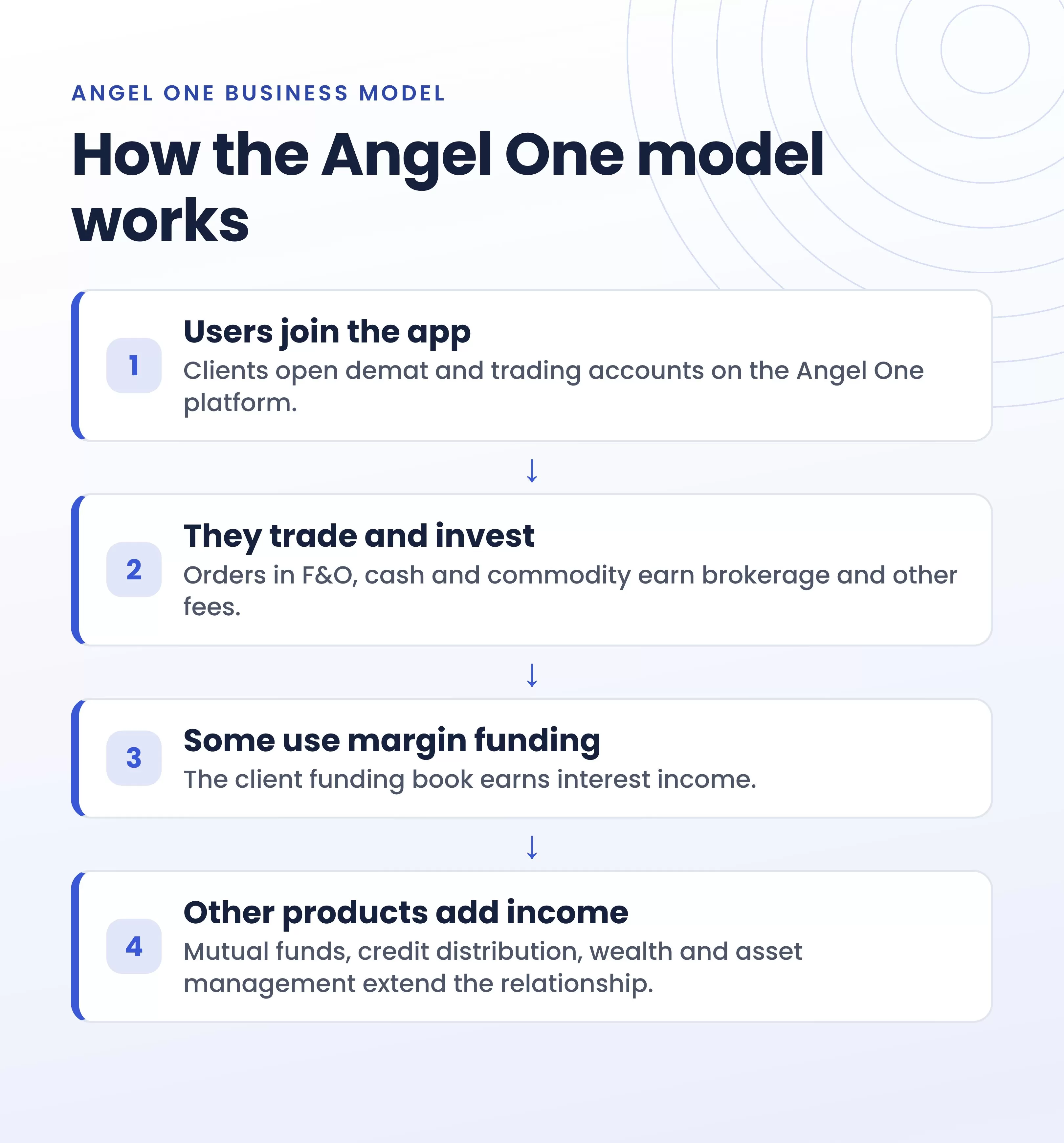
Angel One lets clients open demat and trading accounts and place orders in equity cash, equity derivatives and commodities. Around trading it has added mutual funds, wealth management, an asset management company, credit and a life insurance joint venture.
Its asset management company had 11 schemes and assets under management of ₹5.7 bn as of September 2026. Its wealth management business had assets under management of ₹160.0 bn at the same date.
How the Angel One business model makes money
How Angel One makes money from fees and interest
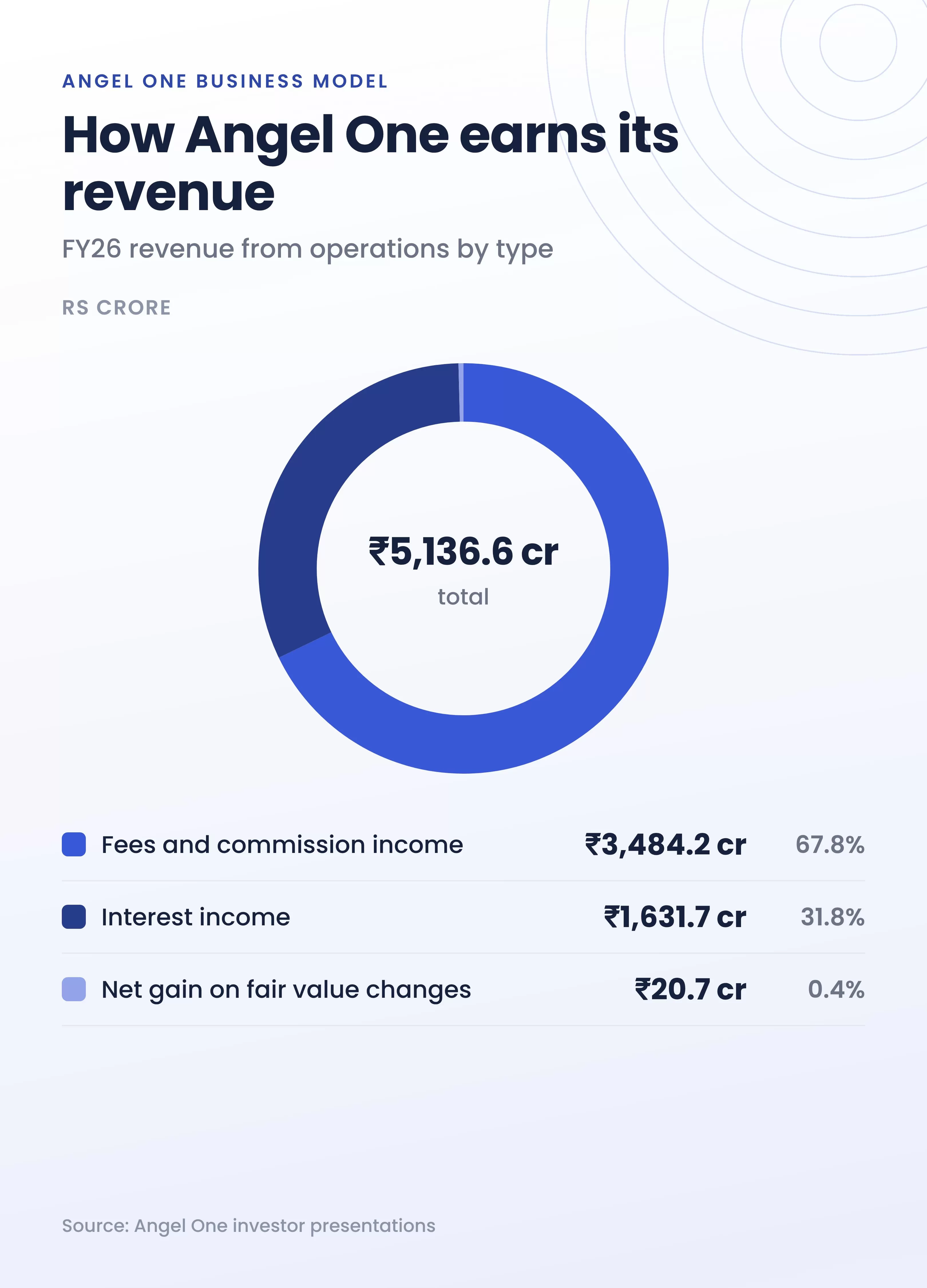
Angel One reports revenue from operations in three lines. In FY26, fees and commission income was ₹3,484.2 crore, interest income was ₹1,631.7 crore and net gain on fair value changes was ₹20.7 crore, which together make the ₹5,136.6 crore total.
Fees and commission income was ₹3,873.9 crore in FY25, so it fell 10.1% in FY26. Interest income was ₹1,341.0 crore in FY25 and rose 21.7% to ₹1,631.7 crore in FY26.
Angel One revenue model by order type
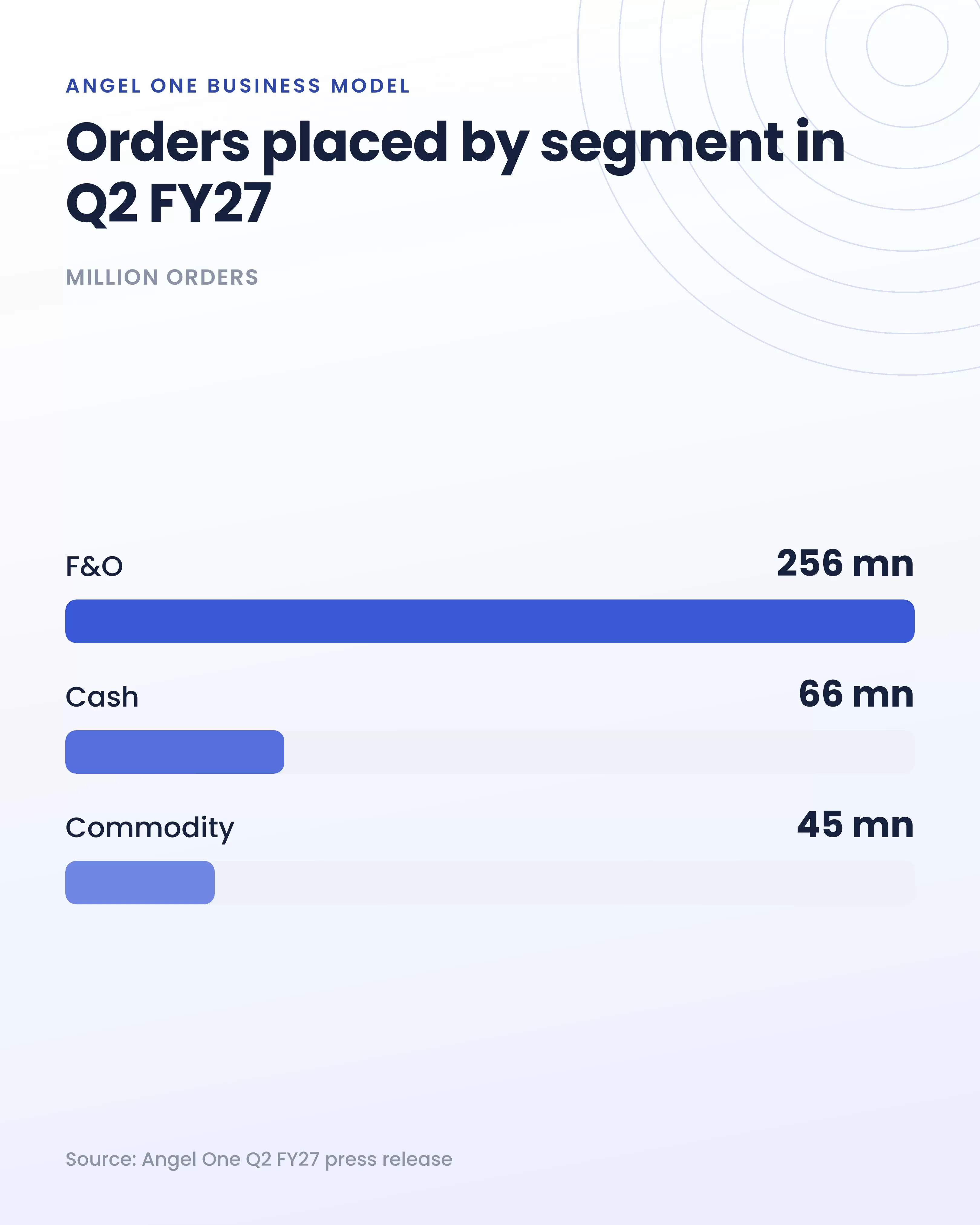
Angel One handled 366 million orders in Q2 FY27, of which 256 million were F&O, 66 million were cash and 45 million were commodity orders (rounded figures).
Angel One margin funding
Margin funding lends money to clients for trades and earns interest. The average client funding book was ₹74.5 bn in Q2 FY27, up 40.5% from a year earlier.
Distribution and wealth
Angel One also distributes products of other providers. In Q2 FY27 credit distribution was ₹6.9 bn, up 51.8% year on year, and unique SIP registrations were 1.9 million, down 19.0% year on year.
Angel One revenue model over five quarters
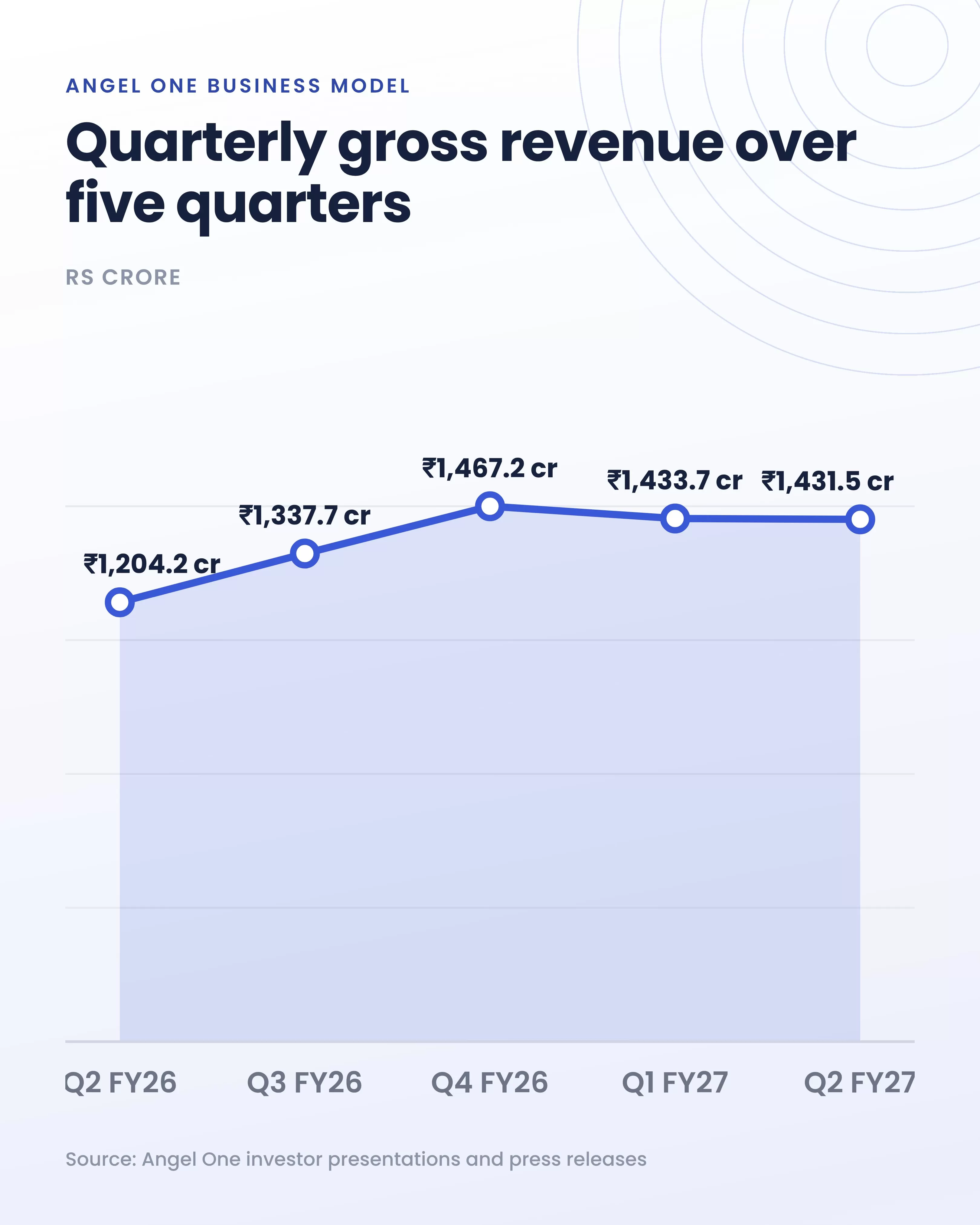
Consolidated gross revenue was ₹1,204.2 crore in Q2 FY26 and ₹1,431.5 crore in Q2 FY27, which is 18.9% higher. Between those two quarters it was ₹1,337.7 crore in Q3 FY26, ₹1,467.2 crore in Q4 FY26 and ₹1,433.7 crore in Q1 FY27.
Angel One's Business Model Canvas
Angel One revenue and profit in FY25 and FY26
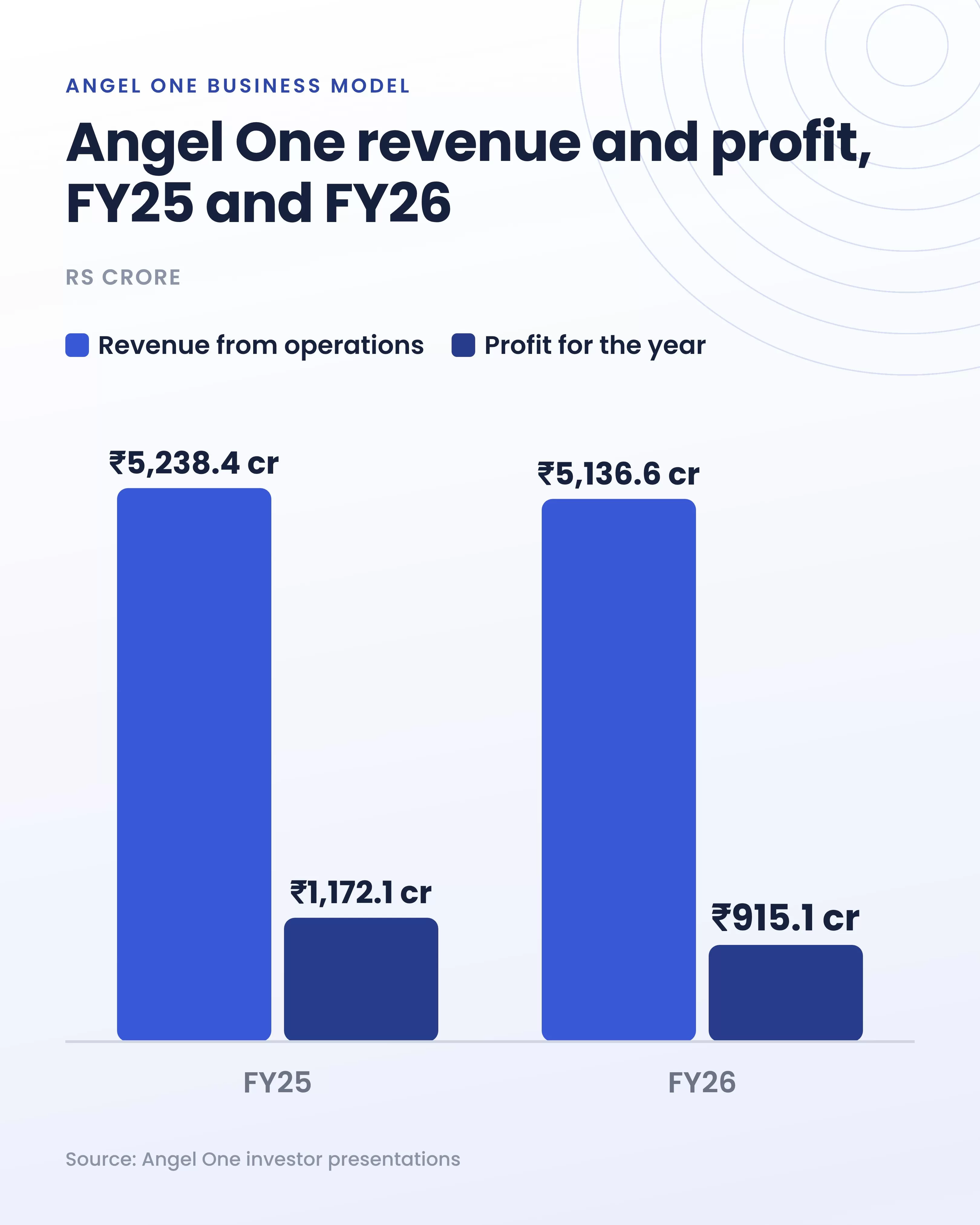
Revenue from operations was ₹5,238.4 crore in FY25 and ₹5,136.6 crore in FY26. Profit for the year was ₹1,172.1 crore in FY25 and ₹915.1 crore in FY26.
Angel One operating metrics
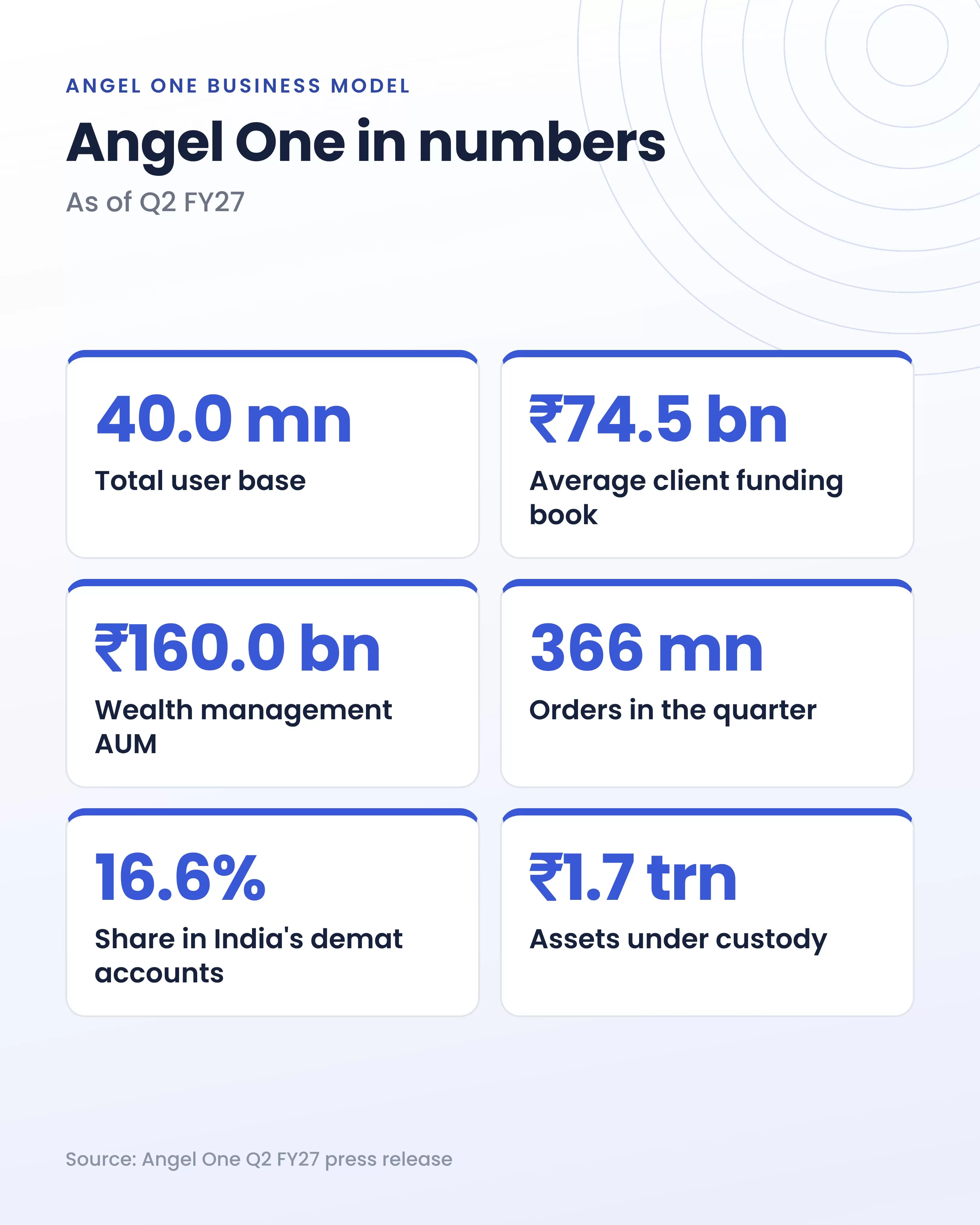
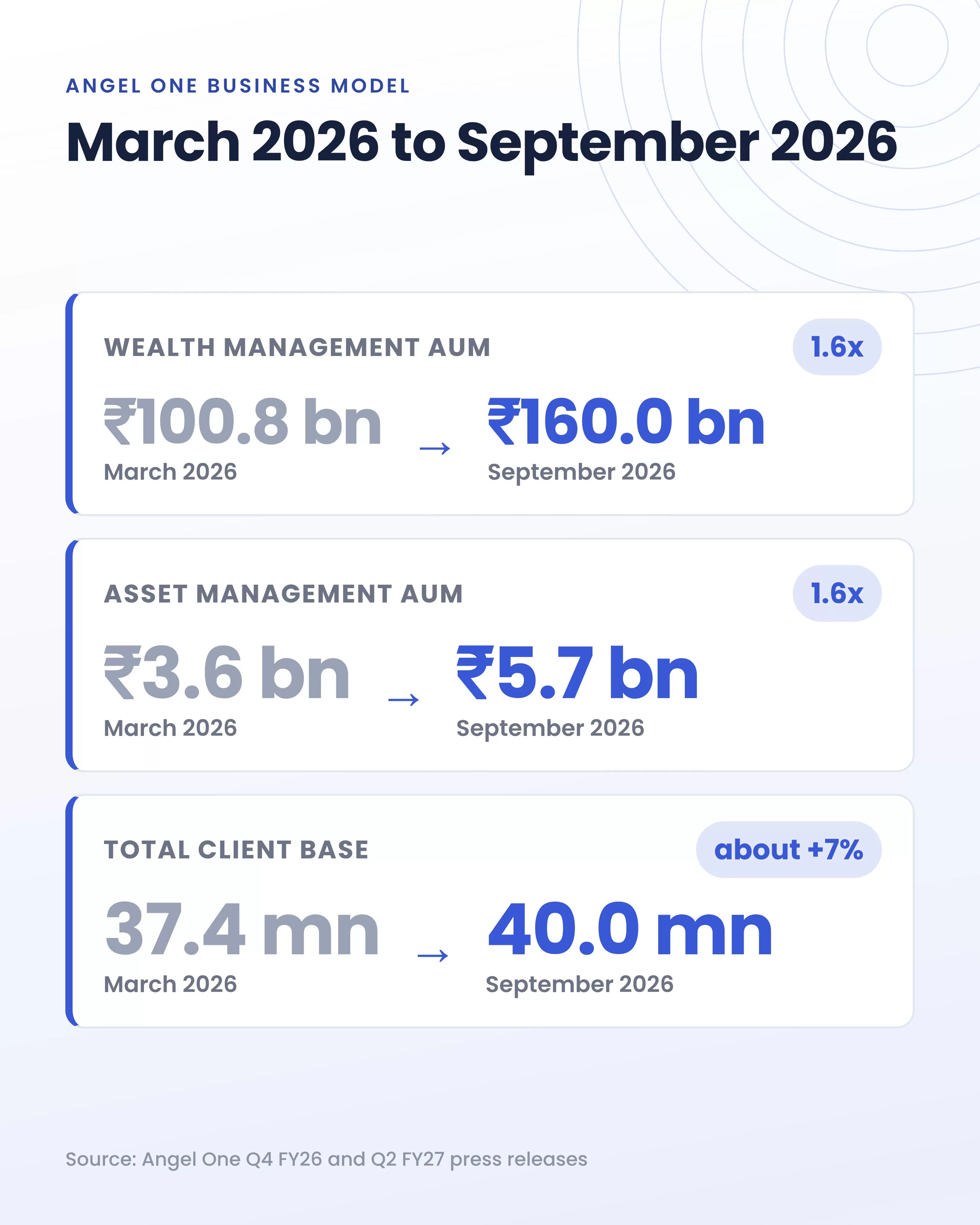
Angel One had a 16.6% share in India's demat accounts and assets under custody of ₹1.7 trn in Q2 FY27. Its total user base grew from 37.4 million in March 2026 to 40.0 million in September 2026. Wealth management assets rose from ₹100.8 bn to ₹160.0 bn and asset management assets from ₹3.6 bn to ₹5.7 bn in the same period.
Angel One's journey so far
| When | What happened |
|---|---|
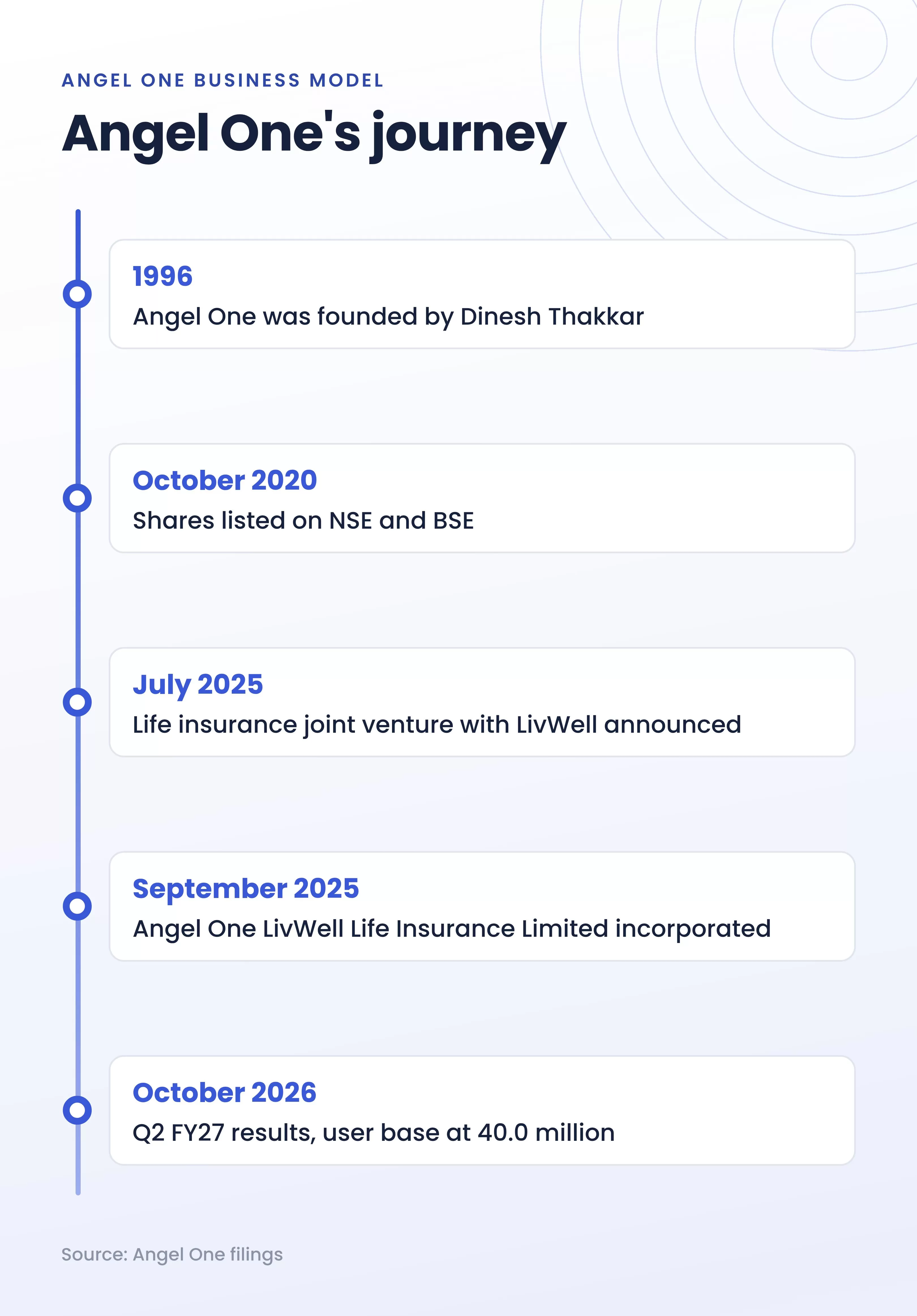
| 1996 | Angel One was founded by Dinesh Thakkar |
| October 2020 | Shares listed on NSE and BSE |
| July 2025 | Life insurance joint venture with LivWell announced |
| September 2025 | Angel One LivWell Life Insurance Limited incorporated |
| October 2026 | Q2 FY27 results reported, with a user base of 40.0 million |
Who Angel One competes with
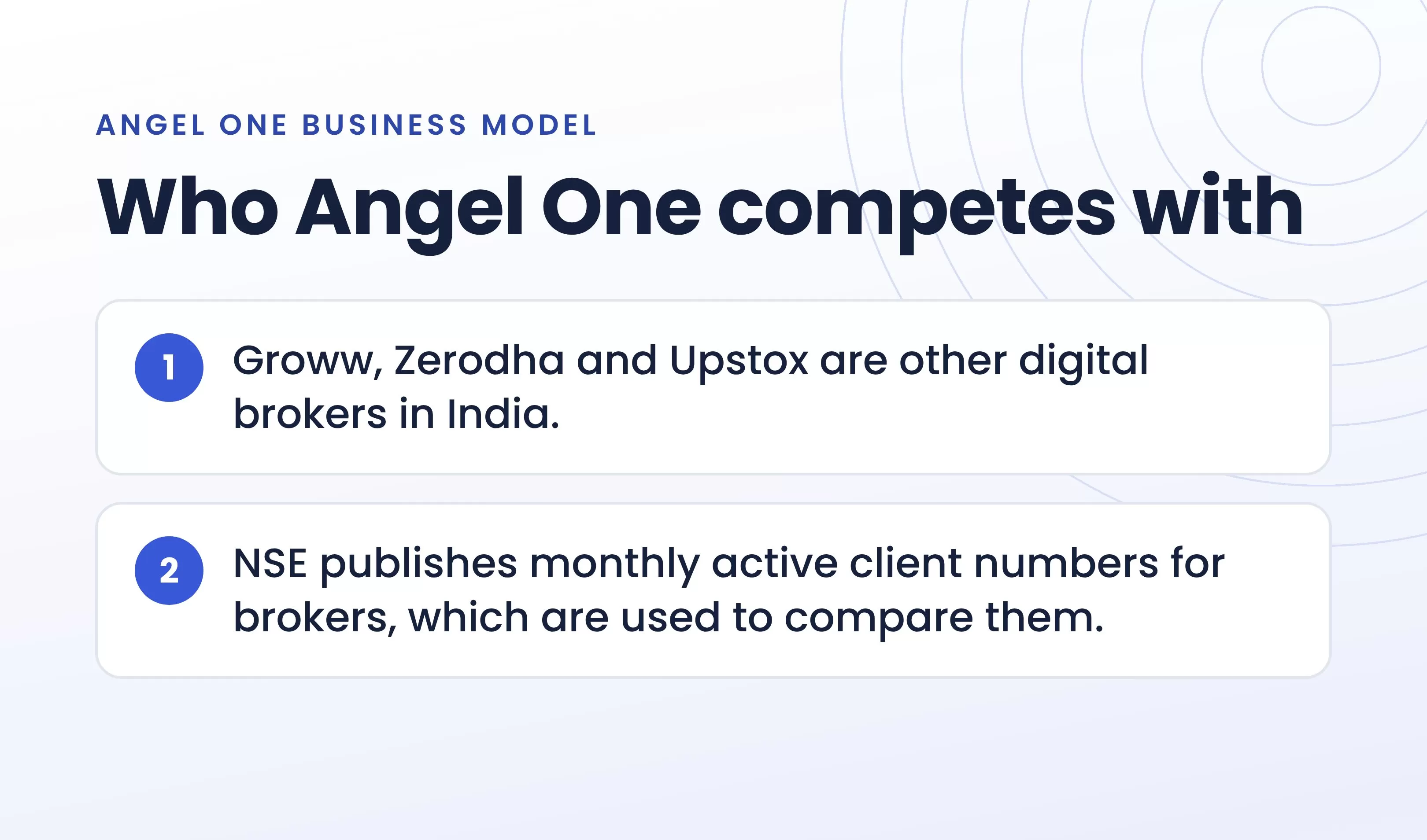
Groww, Zerodha and Upstox are other digital brokers in India. NSE publishes monthly active client numbers for brokers, and these are used to compare them.
Where Angel One's FY26 and Q2 FY27 numbers fell
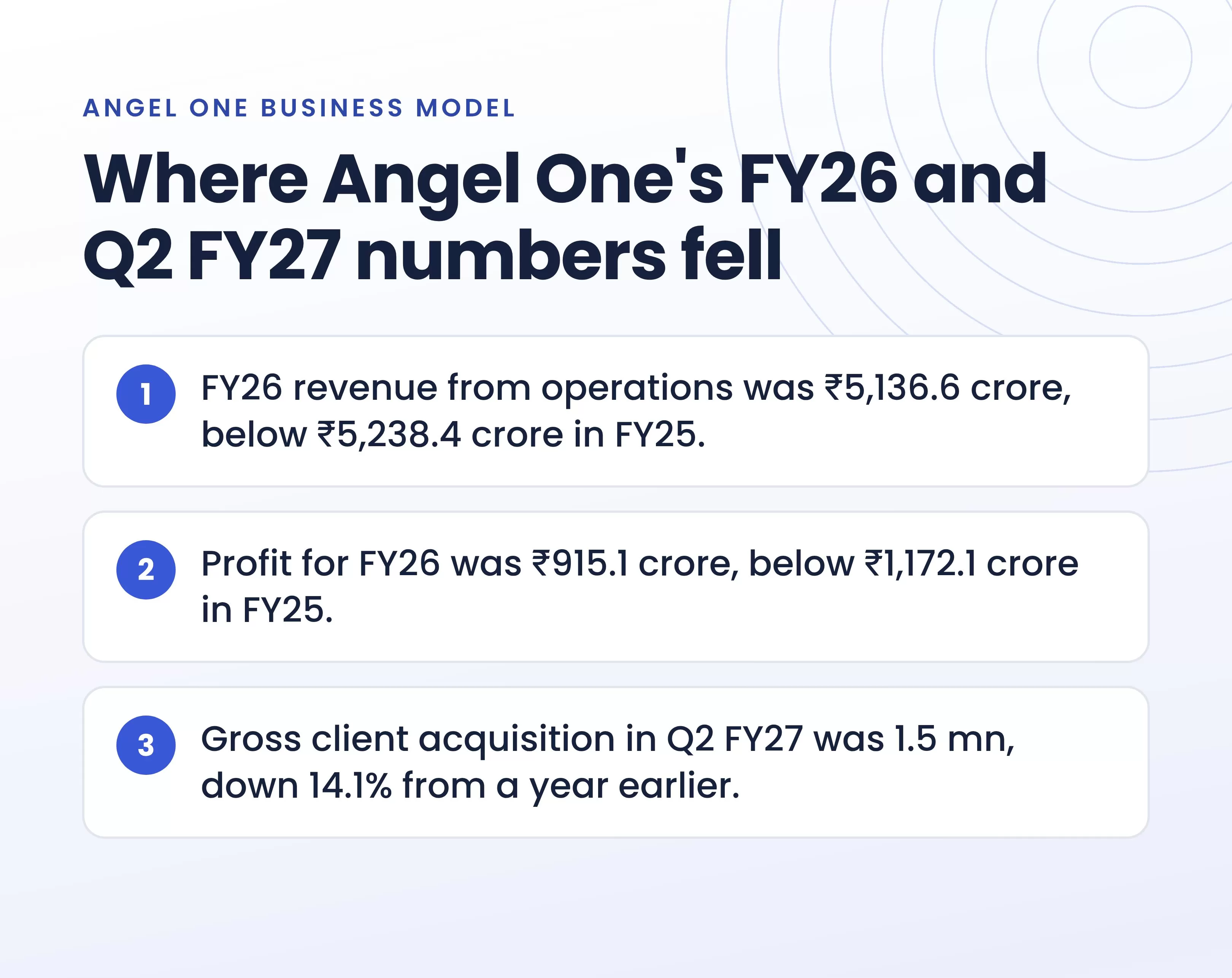
FY26 revenue from operations of ₹5,136.6 crore was below the ₹5,238.4 crore of FY25, and profit for the year of ₹915.1 crore was below ₹1,172.1 crore. In Q2 FY27 gross client acquisition was 1.5 million, 14.1% lower than a year earlier.
Conclusion on the Angel One business model
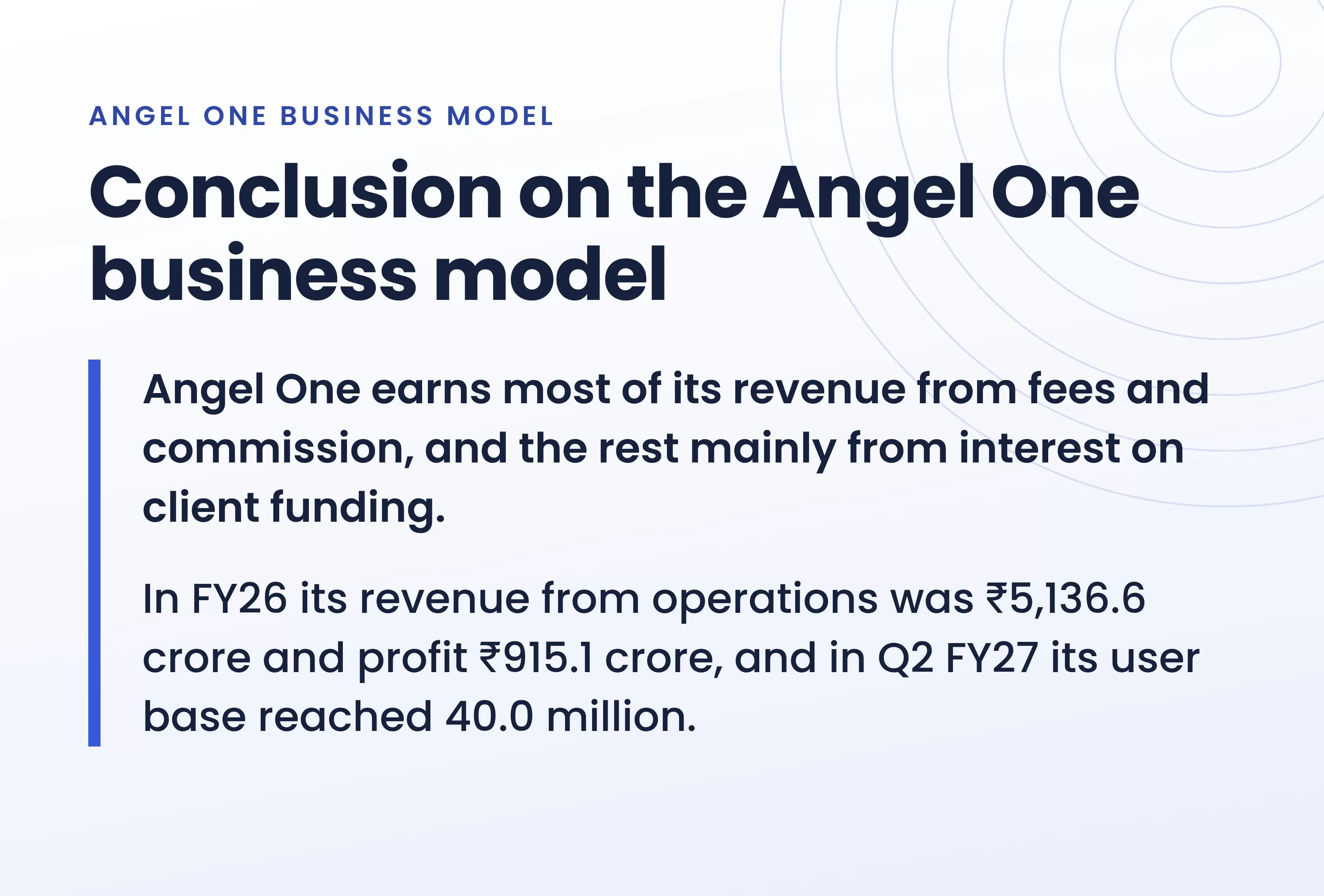
Angel One earns most of its revenue from fees and commission, and most of the rest from interest on client funding. It also offers mutual funds, wealth management, asset management and credit distribution.
In FY26 its revenue from operations was ₹5,136.6 crore and its profit for the year was ₹915.1 crore. In Q2 FY27 its total user base reached 40.0 million.
More from IncBusiness
- Groww Business Model Across Broking, Lending and Wealth
- The Zerodha Business Model of Flat Fee Broking and Margin Funding